
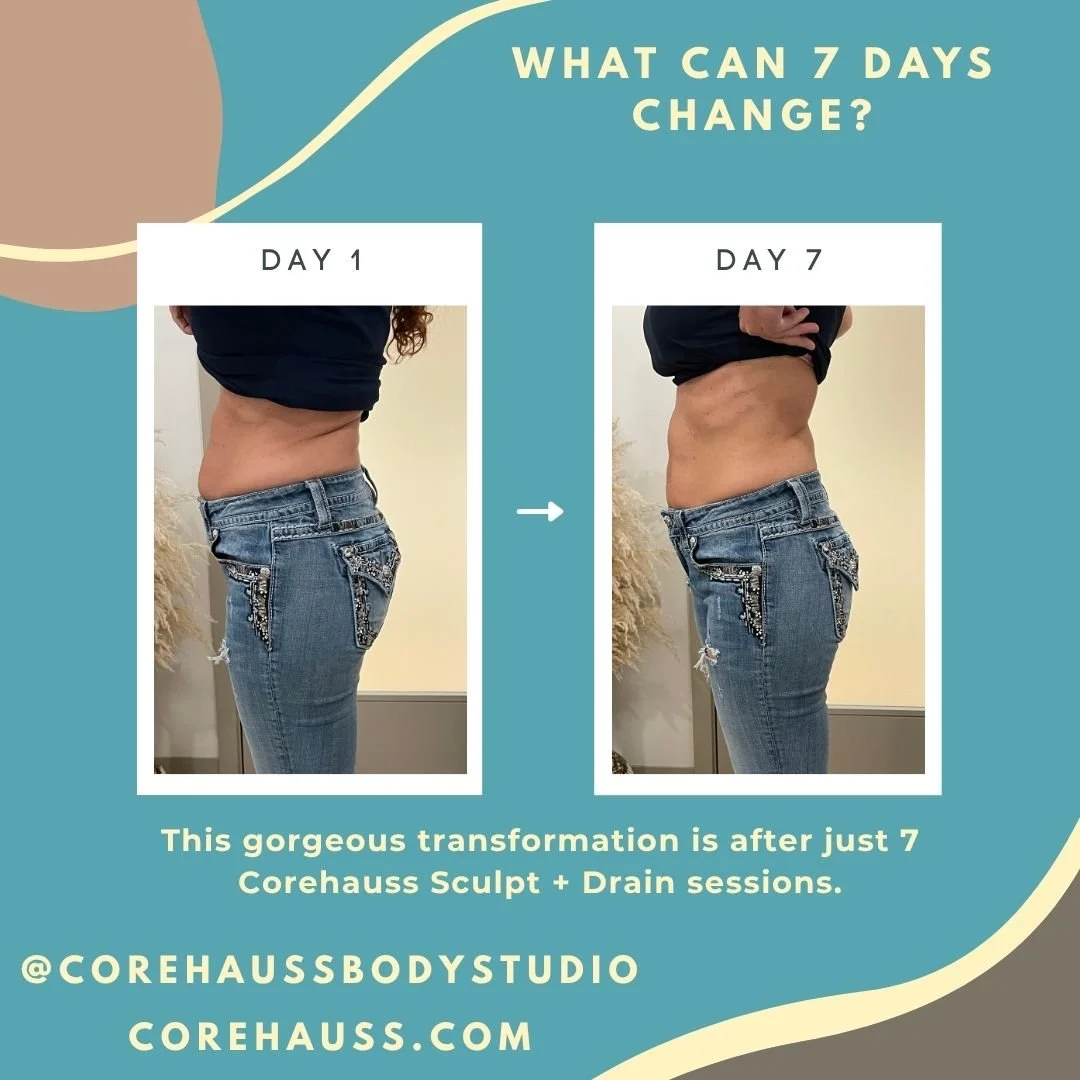
What Can Change in Seven Days? Inside the Corehauss Eurowave Experiment
Before and after - 7 Days with the Eurowave Treatment
Tonight, another group of women begins a focused seven-day Eurowave experiment at Corehauss Body Studio.
Each woman has been asked to bring one specific outfit that is currently just a little too tight. It may be a dress that does not sit the way she wants, a pair of pants that almost buttons comfortably, a fitted top, or an outfit she would simply like to feel better wearing.
For seven consecutive days, each participant will come into the Corehauss studio for approximately 30 minutes and complete a Eurowave session.
No missed days. No disappearing halfway through. No casual commitment.
The purpose of this experiment is simple: to explore what a woman may notice when she commits to seven days of consistent Eurowave sessions while also becoming more aware of how she is sleeping, eating, moving, and feeling in her body.
Why I Created This Experiment
Many women reach a point where their clothing begins to fit differently, even when the number on the scale has not changed dramatically.
This can happen after pregnancy, during perimenopause or menopause, after periods of inactivity, or simply as muscle tone, posture, stress, sleep, and metabolic health begin to shift.
The first response is often frustration.
Women may believe they simply need to eat less, exercise harder, or punish themselves back into an old version of their body.
That is not what this experiment is about.
This is not a crash diet, a starvation challenge, or a promise that every participant will lose a dress size in seven days.
It is an opportunity to observe what may happen when women consistently engage the muscles of the midsection, pay attention to their daily habits, and reconnect with how their body actually feels.
What Is the Eurowave?
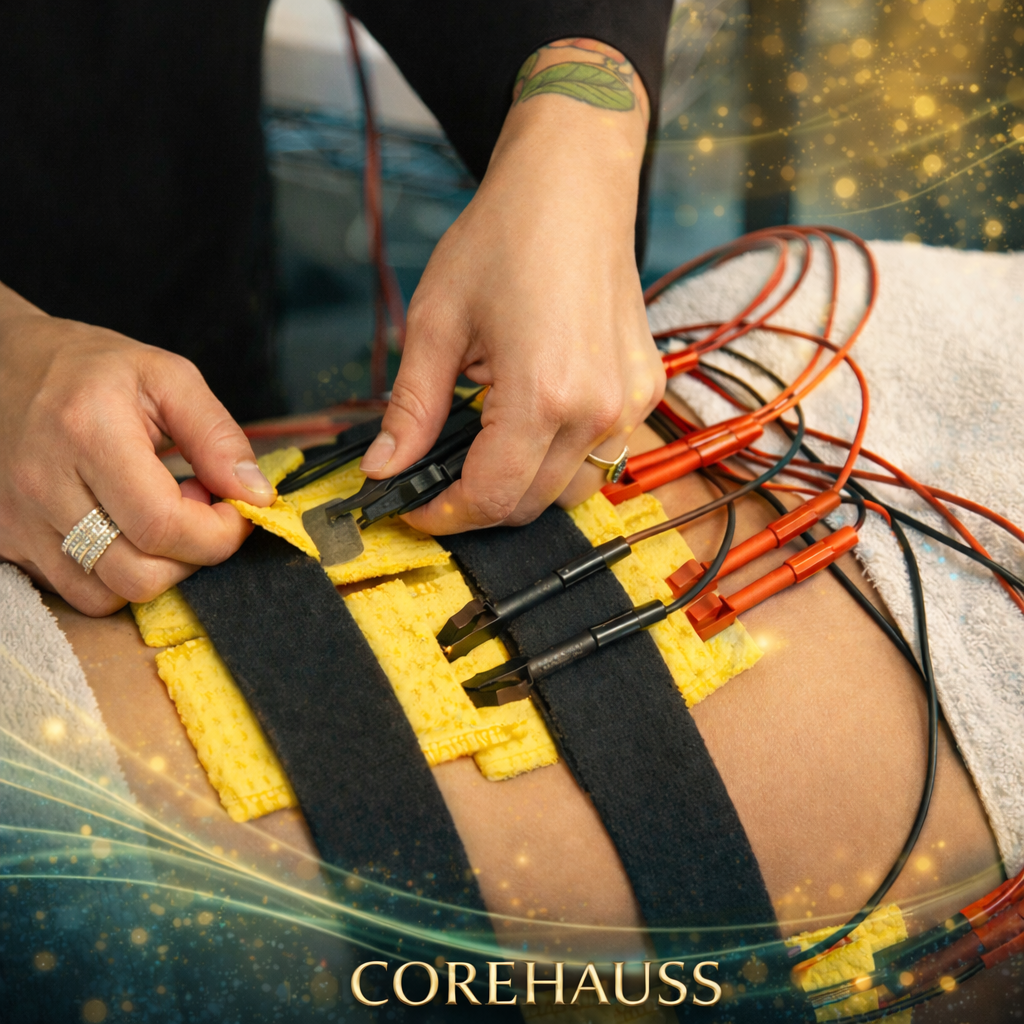
The Eurowave is a non-invasive faradic wave system that stimulates targeted muscle groups through a series of controlled contractions.
During a session, the system works the selected muscle groups without placing additional strain on the joints.
At Corehauss, Eurowave sessions are commonly used to support:
core muscle activation
improved awareness of the midsection
muscle tone and strength
posture and structural support
circulation and lymphatic movement
women who feel disconnected from or weak through their core
The machine is a tool.
It does not replace nutritious food, movement, sleep, strength training, or consistency. It can, however, provide targeted support while a woman works on rebuilding strength and confidence in her body.
What the Participants Will Be Observing
Throughout the seven days, each participant will reflect on her personal experience.
She will pay attention to:
how she is sleeping
how she is feeling physically and emotionally
the food choices she is making
how much she is moving
whether she notices changes in strength
how connected she feels to her core
how she feels in her body as the week progresses
whether her chosen outfit feels different by the end of the experiment
This is not a clinical study, and I am not presenting it as one.
It is a real-world Corehauss experiment involving real women, real schedules, real habits, and real bodies.
The goal is not to force a predetermined result.
The goal is to document the experience honestly.
Why Seven Consecutive Days?
Consistency changes the experience.
One session can introduce a woman to the Eurowave, but seven consecutive days gives her an opportunity to notice patterns.
She may become more aware of how certain foods affect bloating or energy. She may recognize that poor sleep changes how her body feels the next day. She may notice improved muscle engagement, better posture, or a stronger sensation through her core.
She may also realize how often she has been disconnected from her body.
That awareness matters.
Transformation rarely begins with perfection. It usually begins when we start paying attention.
This Is About More Than Fitting Into an Outfit
The outfit creates a visible and relatable goal, but the deeper purpose is not simply squeezing into a smaller space.
Many women have clothing hidden in their closets that represents more than fabric.
It may represent a past version of themselves.
It may represent confidence, femininity, strength, freedom, or the desire to feel comfortable in their body again.
However, I do not want women believing that their worth depends on whether a zipper closes.
The outfit is simply a reference point.
The more important questions are:
Do you feel stronger?
Do you feel more supported?
Are you sleeping better?
Are you becoming more conscious of your choices?
Do you feel more confident and connected to your body?
Those changes are worth paying attention to, even when they cannot be captured perfectly in a photograph.
Honest Results Matter
Before-and-after marketing can easily become exaggerated, manipulated, or misleading.
That is not what I want for Corehauss.
Participants will be photographed with their permission, and their feedback will reflect their own genuine experience.
Results will vary because every woman arrives with a different body, history, level of activity, sleep pattern, food intake, and starting point.
Some women may notice a difference in how their clothing fits.
Others may notice more strength, less bloating, improved awareness of their core, or simply greater motivation to take care of themselves.
Every honest observation gives us useful information.
What Happens After the Seven Days?
At the end of the week, each woman will try on her selected outfit again and reflect on the experience.
We will discuss what she noticed, what changed, what did not change, and what she may need to continue working on.
Seven days is a beginning, not a complete transformation.
Lasting strength and metabolic health require continued action. That may include additional Eurowave sessions, resistance training, walking, supportive nutrition, improved sleep, stress regulation, and consistent daily habits.
The experiment opens the door.
The participant still chooses whether she walks through it.
Interested in Experiencing Eurowave?
You do not need to wait for another complimentary trial to begin working with me.
Corehauss Body Studio offers private Eurowave sessions for women who want support with core strength, muscle activation, body confidence, and feeling more connected to their midsection.
Every woman begins with an intake so we can discuss her goals, health history, expectations, and whether Eurowave is an appropriate fit.
To inquire about private sessions or future Corehauss opportunities, contact me directly through the website or send me a message through Facebook or Instagram.
Corehauss is located in St. Albert, Alberta.
Strength lives here—and it begins with showing up.
Inside Our First 7-Day Eurowave Trial
Eurowave at Corehauss
Our first Corehauss 7-Day Eurowave Trial is now underway, and the women participating are doing extremely well.
The purpose of this trial is simple: to see what happens when real women complete seven consecutive Eurowave sessions while also following a straightforward metabolic-support protocol.
This is not about promising dramatic overnight weight loss. It is about documenting real experiences, real feedback, real measurements and real photographs.
With three sessions still remaining, the early observations have already been encouraging.
What Participants Are Noticing
Several women have reported:
Reduced abdominal bloating
Waking up feeling slimmer through the midsection
Clothing fitting differently
Greater awareness and activation through the abdominal muscles
Improved sleep
Feeling more motivated and connected to their bodies
These are individual experiences, and each participant will respond differently. We are not assuming that every change is caused by one single factor.
The women are not only receiving Eurowave sessions. They are also following a simple seven-day protocol designed to support their bodies during the experiment.
What the Women Are Doing Differently
During the trial, participants have been encouraged to:
Prioritize protein at each meal
Include enough natural fat to stay satisfied
Avoid added sugar
Reduce refined and starchy carbohydrates
Temporarily remove dairy
Drink at least 64 ounces of water daily
Complete a Japanese interval walk, rebound or another form of purposeful movement
Get to bed earlier
Avoid alcohol
Eat structured meals instead of grazing throughout the day
One of the central ideas we are testing is the power of temporary simplicity.
At Corehauss, we call this normalizing boring.
That does not mean food has to be unpleasant. It means removing the constant complexity, snacking, treats, recreated desserts and highly stimulating foods long enough to hear the body more clearly.
For a short period, meals can be simple:
One primary protein
Basic ingredients
Minimal processing
Enough natural fat for satiety
Repeatable meals that do not require constant decision-making
Sometimes metabolic health does not need another complicated recipe or another trendy plan.
Sometimes the body needs consistency.
Why We Are Looking Beyond the Scale
The scale is only one piece of information, and it is not always the most important one.
During this trial, we are also paying attention to:
Abdominal measurements
Bloating
Clothing fit
Core strength and activation
Sleep
Energy
Hunger and cravings
Digestion
Confidence
How each woman feels in her own body
A woman may notice that she wakes up less bloated, feels stronger through her centre or fits into clothing differently before she sees a major change on the scale.
Those observations matter.
The Metabolic Side of the Trial
Many women have been taught to think only in terms of calories, weight and willpower.
But the body is also responding to hormones, sleep, muscle activity, food quality, stress and metabolic signals.
Two of the most important players are glucose and insulin.
Glucose is a form of sugar circulating in the blood. Insulin is the hormone that helps move glucose out of the bloodstream and into the cells, where it can be used or stored.
When the body becomes less responsive to insulin, the pancreas may need to produce more of it to manage the same amount of glucose. This can affect hunger, cravings, energy and how easily the body accesses stored fuel.
That is why the trial includes more than machine sessions.
Protein, natural fat, fewer refined carbohydrates, structured meals, movement, sleep and muscle activation all form part of the larger metabolic picture.
The goal is not perfection.
The goal is to change the signals the body receives repeatedly.
Why Eurowave Is Only One Part of the Process
Eurowave is a tool designed to stimulate and contract the muscles.
For many women, one of the first things they notice is how disconnected they have become from their abdominal muscles.
They may struggle to consciously engage the core, sit up easily, maintain posture or feel strong through the midsection.
The sessions may help create a stronger awareness of those muscles and provide an intense contraction experience.
However, Corehauss does not believe that one machine replaces nutrition, movement, sleep or personal responsibility.
The most powerful approach is to combine the tool with the behaviours that support metabolic health and physical strength.
That is what this trial is exploring.
Real Women and Real Documentation
The original promotional image used for this trial was an AI-generated concept image. It was intended to illustrate the idea of testing how the same outfit might fit after seven days.
It was not a photograph of a participant or a guaranteed representation of results.
The entire purpose of this trial is to replace the concept with real documentation.
Once the final three sessions are complete, we will be sharing participant photographs, measurements and feedback with their permission.
The images will be presented transparently, and individual results will vary.
What Happens After the Seven Days?
The seven-day trial gives us an opportunity to observe how each woman responds.
The regular Corehauss Eurowave cycle consists of 12 sessions, so trial participants will also have the opportunity to complete their remaining five sessions.
Some participants may choose to continue through the Finish Strong Metabolic Reset, which combines the final five Eurowave sessions with a short metabolic coaching program focused on:
Protein and satiety
Glucose and insulin education
Simple meal structure
Movement
Sleep
Hydration
Muscle
Identity and habit change
The goal is to help women understand that lasting change is not created by a machine alone.
It is created when the tools, behaviours and identity begin working together.
Our Next Trial Begins August 4, 2026 - THIS TRIAL IS NOW FULL
The next 7-Day Eurowave Trial begins on August 4, 2026, at Corehauss Body Studio in St. Albert.
Participants must be able to attend all seven consecutive sessions and follow the supporting protocol as closely as reasonably possible.
This trial may be a good fit for women who want to:
Feel more connected to their core
Reduce bloating
Test a simple metabolic routine
Improve consistency
Experience Eurowave
Learn how food, movement and sleep affect their body
Document their individual results honestly
Spaces are limited.
To ask questions or apply for the next trial, contact Corehauss Body Studio directly.
Strength Lives Here
At Corehauss, the goal is not simply to help women become smaller.
The goal is to help women become stronger, more metabolically capable and more confident in their bodies.
The first trial group still has three sessions remaining, and we are excited to see what the final results reveal.
Real women.
Real experiences.
Real results documented honestly.
Individual experiences and results will vary. Eurowave sessions and Corehauss programs are intended for general wellness and are not a substitute for medical care, diagnosis or treatment.

Your Habits Don't Create Your Identity
Your habits don’t create your identity, your identity creates your habits.
Your Identity Creates Your Habits.
Most women have been taught that if they could only become more disciplined...
...they would finally lose the weight.
If they could just eat better.
Exercise harder.
Stop emotional eating.
Be more motivated.
Then everything would change.
But after coaching women—and living through my own journey—I don't believe that's where transformation begins.
It begins much deeper.
It begins with identity.
We Have It Backwards
Think about how most people try to change.
They decide they want to lose 30 pounds.
So they buy healthier groceries.
Join a gym.
Download another calorie tracker.
Promise themselves that this Monday will be different.
For a few weeks they stay motivated.
Then life happens.
Stress returns.
Old habits creep back in.
The weight comes back.
Not because they failed...
Because they were trying to build new habits while still believing they were the same person.
Your Brain Always Tries To Stay Consistent
Your subconscious loves consistency.
If deep down your identity says...
"I'm overweight."
"I've always struggled."
"I'm not athletic."
"I have no willpower."
"I always quit."
Then your brain will quietly steer your actions back toward proving those beliefs true.
Not because you're broken.
Because your identity always wins.
Your habits are simply evidence of who you believe you are.
Every Choice Is An Identity Vote
James Clear talks about this beautifully in Atomic Habits.
Every action is a vote for the person you're becoming.
I like to take it one step further.
Every action is also evidence for the identity you're already practicing.
You don't eat healthy because you're disciplined.
You eat healthy because you're becoming someone who values her health.
You don't go for a walk because you're forcing yourself.
You go because that's what a healthy woman naturally does.
Healthy choices become easier when they match who you believe you are.
This Is Why Diets Fail
Diets focus almost entirely on behavior.
Calories.
Macros.
Meal plans.
Rules.
Restrictions.
But very few ever ask the question:
Who does this woman believe she is?
Because until that changes...
Nothing truly changes.
Identity Before Habits
Inside the Corehauss Metabolic Reset, this is where we begin.
Before we talk about protein...
Before fasting...
Before weighted walks...
Before strength training...
We build your future identity.
We design your future self.
The woman who:
Wakes up with energy.
Loves moving her body.
Eats in a way that nourishes her.
Feels strong.
Thinks clearly.
Trusts herself.
Keeps promises to herself.
Doesn't need motivation because this is simply who she is.
Once that identity becomes familiar...
The habits stop feeling forced.
They become natural.
Ask Yourself This Today
Instead of asking:
"What should I eat today?"
Try asking:
"What would the healthiest version of me choose?"
Instead of asking:
"Do I feel like exercising?"
Ask:
"What would the woman I'm becoming do today?"
One question comes from your current identity.
The other comes from your future one.
Guess which one changes your life.
Lasting Change Starts Here
You don't become healthy because you lose weight.
You lose weight because you've become someone who consistently makes healthy choices.
Identity comes first.
Habits follow.
And when your habits finally match who you believe you are...
Change stops feeling like hard work.
It simply becomes who you are.
Your Corehauss Challenge This Week
Take five minutes today and write one sentence.
"I am the woman who..."
Finish that sentence as if you're already living the life you want.
Maybe it's:
I am the woman who fuels her body with real food.
I am the woman who enjoys movement every day.
I am the woman who keeps promises to herself.
I am the woman who is metabolically healthy, strong, and full of energy.
Then tomorrow...
Act like her.
Not perfectly.
Just once.
Because every choice is another vote for the woman you're becoming.
Why Most Women Don’t See Results from Body Sculpting (And What Actually Works)
Mother’s Day just passed.
And if you’re like most women, you spent it taking care of everyone else…
while quietly thinking:
“I need to get back on track.”
You’re not alone.
But here’s the truth most places won’t tell you:
It’s not that your body isn’t responding.
It’s that the approach you’ve been sold doesn’t work long-term.
The Real Problem
Most body sculpting treatments are built around:
One-off sessions
High price tags
No structure
And the expectation?
That your body will somehow change from occasional effort.
It won’t.
Your body responds to:
repetition
stimulus
consistency
Why “One Session” Doesn’t Work
Think about this logically.
You wouldn’t:
go to the gym once
eat well for one day
walk once around the block
…and expect lasting results.
But that’s exactly how most treatments are sold.
Results aren’t created in one session.
They’re built over time.
What Actually Works (This is your authority moment)
At Corehauss, we do things differently.
Instead of focusing on one-off treatments, we focus on:
Frequency (3x per week)
Muscle activation
Lymphatic support
Structured progression
This allows your body to:
adapt
strengthen
respond
The Mindset Shift
You don’t need:
a more expensive treatment
a trendier machine
a “miracle solution”
You need:
a system your body can actually respond to
If you’ve been telling yourself:
“I’ll start Monday…”
This is your moment.
Not another reset.
Not another false start.
A real structure that works.
Perimenopause & Muscle Loss in St. Albert: Why Strength Feels Different After 40
Confident midlife woman in neutral gym setting
Many women in St. Albert notice that sometime in their late 30s or 40s, strength begins to feel different.
Workouts that once worked stop delivering results. Recovery takes longer. Midsection stability feels less reliable. Energy fluctuates.
This is not a lack of discipline.
It is perimenopause.
During perimenopause, shifting estrogen and progesterone levels influence muscle coordination, stress tolerance, and metabolic responsiveness. For women across St. Albert and the greater Edmonton area, this often shows up as:
• Increased abdominal softness
• Reduced muscle tone despite effort
• Slower recovery from workouts
• A feeling of instability during movement
Many women respond by increasing intensity.
But intensity without coordination can reinforce compensation patterns.
Strength during perimenopause benefits from sequencing.
Before load comes communication.
Structured muscle activation helps restore connection between the nervous system and stabilizing muscles. When coordination improves, strength becomes more accessible again.
At Corehauss in St. Albert, women navigating perimenopause use guided muscle activation to rebuild stability before increasing intensity.
For women in St. Albert and Edmonton, this foundation-first approach allows strength to return without forcing the body through stress it can no longer tolerate the same way.
If strength feels different after 40, it likely is.
The solution isn’t pushing harder.
It’s training smarter.
Click here to access my schedule for an appointment

Tissue Quality: Why Tone Is More Than Muscle
Body tone is influenced by more than muscle alone. Tissue quality, circulation, and support play a key role in how the body feels and responds during change.
Many people think body tone comes down to muscle alone.
But muscle is only part of the picture.
What most people are actually responding to when they say a body looks or feels “tight” or “firm” is tissue quality — the health of the connective tissues, fascia, and fluid systems that surround and support muscle.
This is why two people with similar muscle mass can look and feel very different.
What Tissue Quality Really Means
Tissue quality refers to how well your tissues:
hold shape
respond to movement
circulate fluid
transmit tension
Healthy tissue feels:
responsive, not rigid
supported, not heavy
firm without strain
When tissue quality declines, the body may feel:
softer
less defined
puffy
less connected
This can happen even when weight is lost or muscle is present.
Why Tissue Quality Changes During Weight Loss
During periods of change, the body often experiences:
reduced mechanical stimulation
altered circulation
shifts in lymphatic flow
nervous system adaptation
Without consistent stimulation, tissues adapt by becoming less responsive.
This is not damage.
It’s adaptation.
And it can be supported.
Why Muscle Alone Doesn’t Solve This
Traditional exercise focuses on muscle contraction, but not always on:
sustained tissue engagement
gentle rhythmic stimulation
fluid movement through tissues
That’s why some people train regularly but still feel:
soft
heavy
unsupported
The missing piece is often how tissues are being stimulated — not how hard.
Supporting Tissue Quality Gently
Supportive approaches focus on:
consistent activation
rhythmic stimulation
low stress on the nervous system
improved circulation and awareness
This is where non-invasive technologies like Eurowave are used — not to replace movement or medical care, but to support tissue responsiveness during periods of change.
The Takeaway
Tone is not just muscle.
It’s tissue health, fluid movement, and responsiveness.
When tissue quality improves, bodies often feel:
firmer
lighter
more supported
more confident
Not because they’re smaller — but because they’re better supported.
👉 Learn more about Eurowave sessions at Corehauss
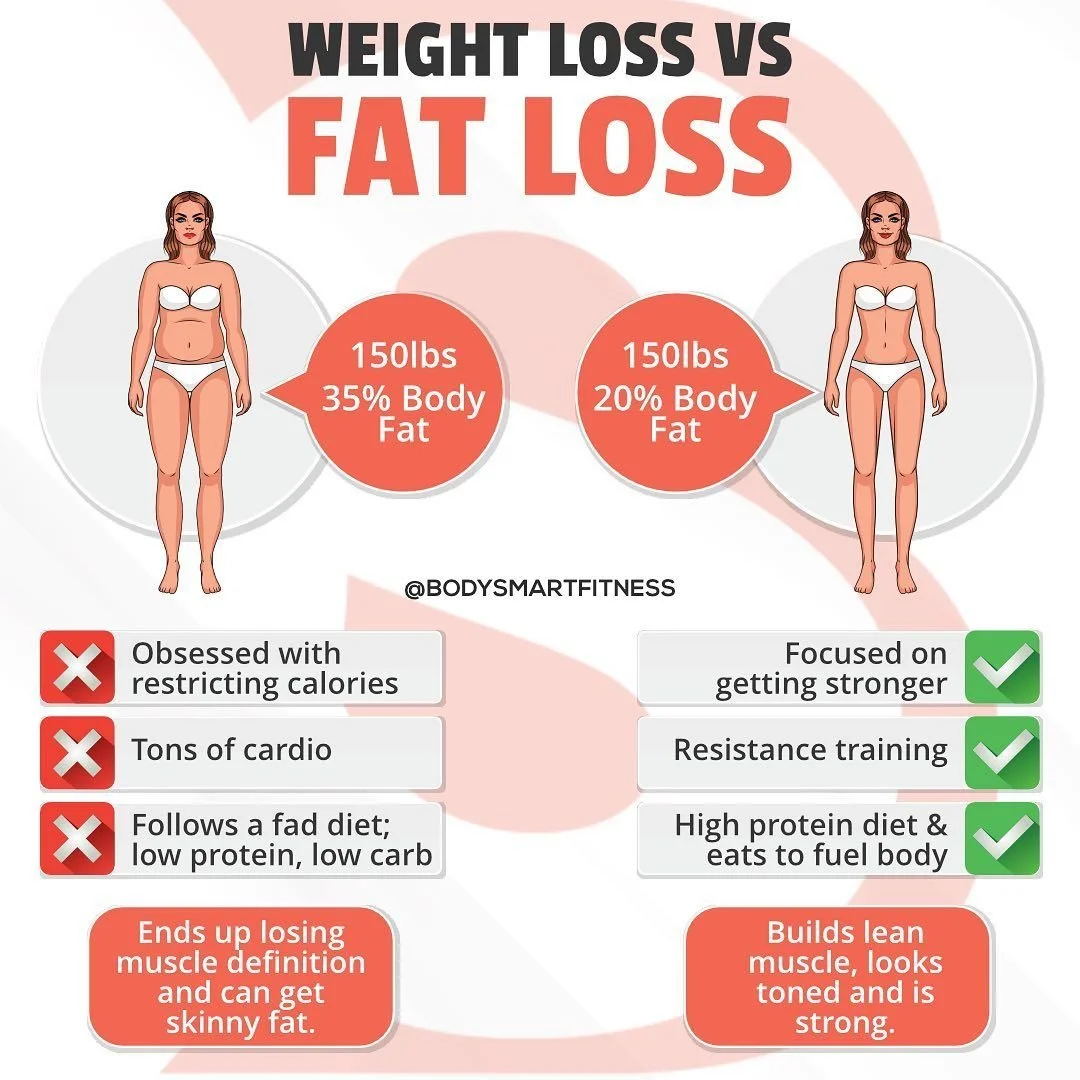
Why Rapid Weight Loss Can Change How Your Body Feels — Not Just How It Looks
Weight loss is often framed as a visual outcome.
But many women are surprised to find that when weight changes quickly, the biggest shift isn’t what they see in the mirror — it’s how their body feels.
Comments like these are incredibly common:
“I feel smaller, but softer.”
“My strength feels different.”
“I’ve lost weight, but I don’t feel as solid.”
“My body doesn’t feel supported the way it used to.”
These experiences are not a sign that something has gone wrong.
They’re a sign that body composition is changing faster than structure can adapt.
Weight Loss and Body Composition Are Not the Same Thing
The scale measures total mass.
It does not tell you what that mass is made of.
Your body is a combination of:
muscle
fat
water
connective tissue
fascia
When weight drops quickly — for any reason — the body may lose:
fat
fluid
muscle tone
That loss of tone is often what creates the sensation of softness, weakness, or instability — even as the number on the scale goes down.
This is why focusing only on weight can feel confusing or discouraging.
Why the Body Can Feel “Less Supported” During Rapid Change
Muscle provides more than strength.
It provides structure.
When muscle activation decreases:
posture can feel less stable
joints may feel less supported
the core may feel weaker
tissues may feel looser or less responsive
This doesn’t mean muscle is “gone forever.”
It means it needs intentional activation again.
And during periods of rapid weight change, that activation often doesn’t happen naturally.
Softness Is a Signal — Not a Failure
Softness during weight loss is often interpreted as something negative.
But from a physiological perspective, it’s simply information.
It can signal:
reduced muscle engagement
less resistance placed on the body
lower daily movement intensity
changes in nervous system signaling
changes in circulation and fluid dynamics
In other words, the body is adapting — and asking for support.
Why Long-Term Metabolic Health Depends on Muscle Preservation
Muscle is metabolically active tissue.
It plays a role in:
insulin sensitivity
glucose uptake
posture and balance
joint protection
long-term weight stability
Preserving muscle tone during weight loss isn’t about aesthetics.
It’s about function, resilience, and sustainability.
This is why many women shift their focus from “losing more weight” to:
feeling stronger
feeling tighter
feeling more supported
improving body composition
That shift is often where confidence returns.
Where Supportive Muscle Activation Fits In
During periods of rapid change, the body doesn’t always receive enough stimulus to keep muscles fully engaged.
Supportive activation methods — especially those that are:
non-invasive
low stress
adjustable
and gentle on the nervous system
can help the body:
reconnect to muscle engagement
improve tissue tone
feel more stable and supported
maintain structural integrity during transition
This is the context in which technologies like Eurowave are used — not as treatment, not as replacement for medical care, but as support for the physical structure of the body.
The Takeaway
If your body feels different during weight loss, you’re not doing anything wrong.
You’re experiencing a normal physiological response to rapid change.
The goal isn’t just to be smaller.
The goal is to be strong, supported, and stable inside your body.
That’s where long-term health lives.
A Gentle Invitation
At Corehauss, we focus on supporting muscle activation, tissue tone, and body awareness — especially during periods of change.
If you’re navigating weight loss and want your body to feel more supported along the way, Eurowave may be a helpful tool to explore.
👉 Learn more about Eurowave sessions at Corehauss
Support your structure. Support your strength. Support your long-term health.